Glarner Tödi E
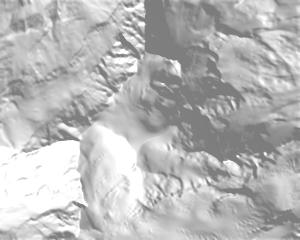
Past extents come from the Swiss Glacier Inventories of 1850, 1931, 1973 and 2016. Future extents are illustrative: each glacier’s projected area (OGGM, median of CMIP6 climate models) is removed from its lowest ice upward. About the scenarios.
Glarner Tödi E is one of 1,400 glaciers in Switzerland, covering 0.17 km² in the canton of Glarus. Its ice spans 3,023 to 3,572 m and faces south-east. Its meltwater drains to the Rhine and on to the North Sea. In 1850, at the end of the Little Ice Age, it covered 0.21 km²; by 2016 it had lost 18% of that area. With strong climate protection (SSP1-2.6), about 2% of its 2020 ice would remain in 2100. With very high emissions (SSP5-8.5) it would be gone around 2052. Its meltwater peaked around 2017.
What remains in 2100
Meltwater
Million m³ of water per year, 11-year mean
Facts
Area over time
Past areas are the ice body this glacier belonged to at the time. Projections: OGGM median, SSP2-4.5.
- SGI id
- A50i-25
- Canton
- Glarus
- River
- Rhine → North Sea
- Basin
- Linth
- Location
- 46.8100° N, 8.9250° E · swisstopo map
- Elevation
- 3,023–3,572 m, median 3,357 m
- Slope, aspect
- 36°, south-east
- Debris cover
- none mapped
- Inventory image
- 2013
- Ice volume (model)
- ≈ 0.003 km³ in 2020 (OGGM)
- RGI ids
- RGI60-11.00951
Sources
- Linsbauer et al. (2021). The new Swiss Glacier Inventory SGI2016. Frontiers in Earth Science 9. doi.org/10.3389/feart.2021.704189
- Mannerfelt et al. (2022). Halving of Swiss glacier volume since 1931 observed from terrestrial image photogrammetry. The Cryosphere 16. doi.org/10.5194/tc-16-3249-2022
- GLAMOS – Glacier Monitoring Switzerland. www.glamos.ch
- Zekollari et al. (2024). Twenty-first century global glacier evolution under CMIP6 scenarios and the role of glacier-specific observations. The Cryosphere 18 (OGGM v1.6 projections). tc.copernicus.org/articles/18/5045/2024/
Relief: swisstopo swissALTIRegio. 1850 and 1973 outlines: Maisch et al. (2000), Müller et al. (1976), Paul (2004). Length, mass balance and volume change: GLAMOS releases 2025. All sources and methods.