Vadret da Morteratsch
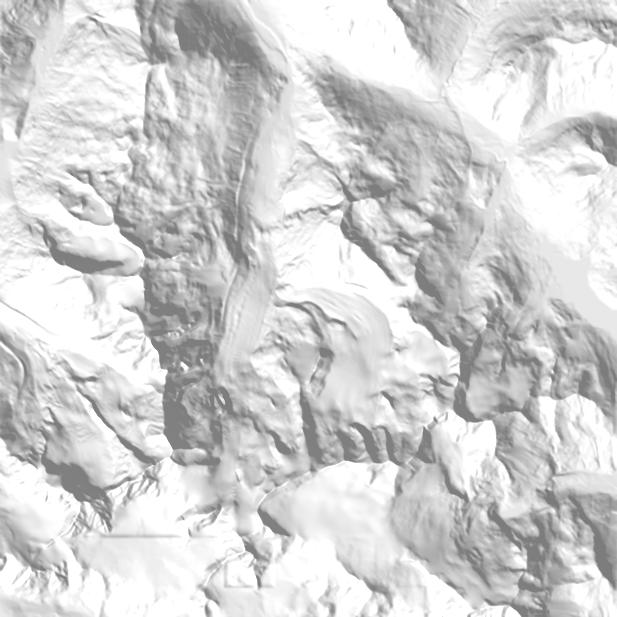
Past extents come from the Swiss Glacier Inventories of 1850, 1931, 1973 and 2016. Future extents are illustrative: each glacier’s projected area (OGGM, median of CMIP6 climate models) is removed from its lowest ice upward. About the scenarios.
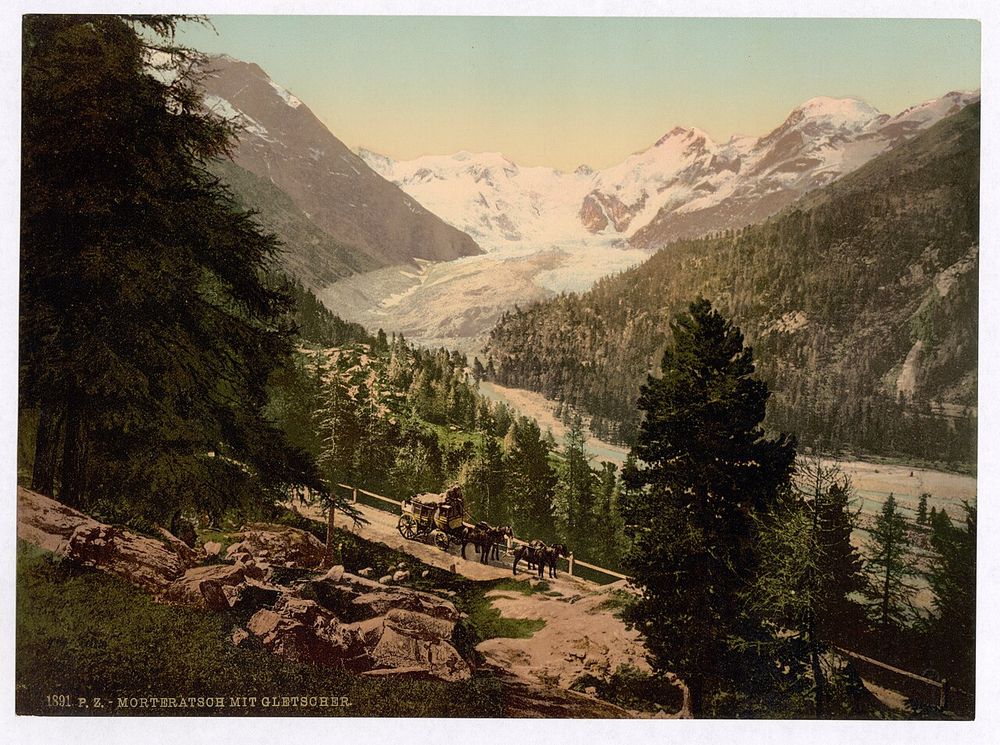
Vadret da Morteratsch is the 7th-largest glacier in Switzerland, covering 14.93 km² in the canton of Graubünden. Its ice spans 2,032 to 4,006 m and faces north. Its meltwater drains to the Inn and on to the Black Sea. In 1850, at the end of the Little Ice Age, it covered 19.26 km²; by 2016 it had lost 22% of that area. Its tongue has been measured 137 times since 1878. In total it has retreated 3,059 m, about 21.0 m a year. Between 1850 and 2022 its surface dropped by 61 m on average. With strong climate protection (SSP1-2.6), about 36% of its 2020 ice would remain in 2100. With very high emissions (SSP5-8.5) it would be gone around 2092. Its meltwater peaked around 2020.
Then and now

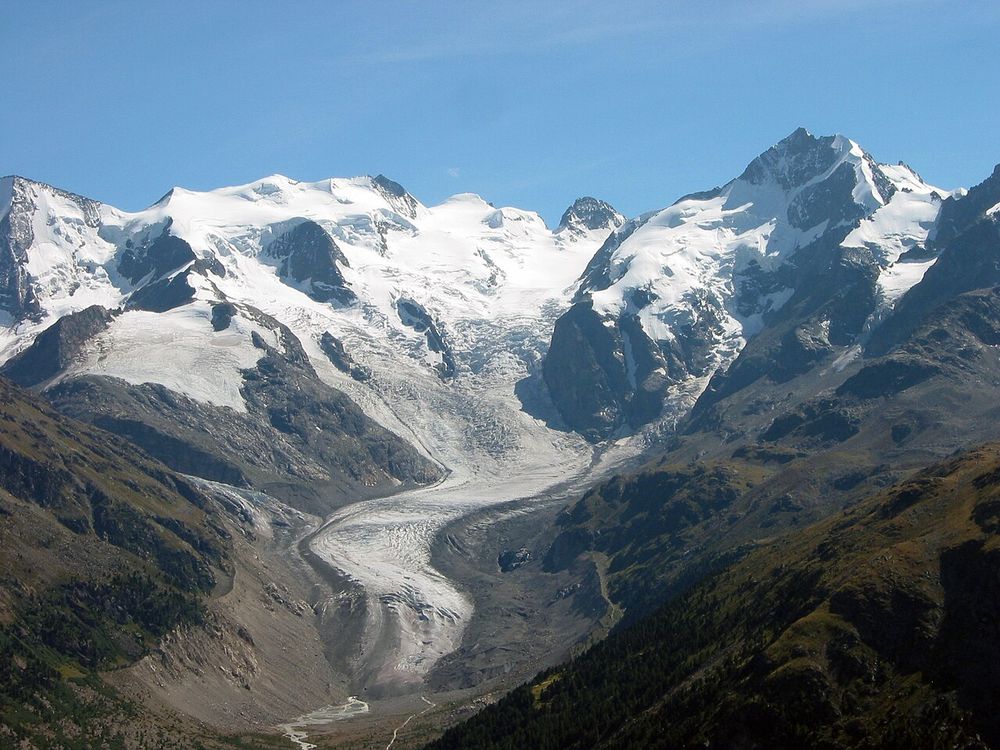

What remains in 2100
Meltwater
Million m³ of water per year, 11-year mean
The record
Length change since 1878
Position of the glacier tongue, measured in the field almost every year. Hover for each measurement.
Thinning since 1850
Average change in surface height, from comparing elevation models made from maps, aerial images and laser scans.
Facts
Area over time
Past areas are the ice body this glacier belonged to at the time. Projections: OGGM median, SSP2-4.5.
- SGI id
- E22-03
- Canton
- Graubünden
- River
- Inn → Black Sea
- Basin
- Inn
- Location
- 46.3833° N, 9.9264° E · swisstopo map
- Elevation
- 2,032–4,006 m, median 3,011 m
- Slope, aspect
- 22°, north
- Debris cover
- 1.62 km² (11% of the area)
- Inventory image
- 2015
- Ice volume (model)
- ≈ 0.915 km³ in 2020 (OGGM)
- RGI ids
- RGI60-11.01946, RGI60-11.02120, RGI60-11.02127, RGI60-11.02138
More in the Inn basin
- Vadret da Roseg6.58 km²
- Vadret da Tschierva5.63 km²
- Vadrec da Fedoz1.90 km²
- Vadret Tiatscha1.87 km²
- Vadret dal Tremoggia1.83 km²
- Vadret da Grialetsch W1.15 km²
- Vadret da Sarsura0.89 km²
- Vadret da Misaun0.84 km²
- Vadret da Grialetsch E0.83 km²
- Vadret da Chalaus0.62 km²
- Vadret Calderas0.61 km²
- Vadret da Fex0.58 km²
Sources
- Linsbauer et al. (2021). The new Swiss Glacier Inventory SGI2016. Frontiers in Earth Science 9. doi.org/10.3389/feart.2021.704189
- Mannerfelt et al. (2022). Halving of Swiss glacier volume since 1931 observed from terrestrial image photogrammetry. The Cryosphere 16. doi.org/10.5194/tc-16-3249-2022
- GLAMOS – Glacier Monitoring Switzerland. www.glamos.ch
- Zekollari et al. (2024). Twenty-first century global glacier evolution under CMIP6 scenarios and the role of glacier-specific observations. The Cryosphere 18 (OGGM v1.6 projections). tc.copernicus.org/articles/18/5045/2024/
Relief: swisstopo swissALTIRegio. 1850 and 1973 outlines: Maisch et al. (2000), Müller et al. (1976), Paul (2004). Length, mass balance and volume change: GLAMOS releases 2025. All sources and methods.